Beyond Implementation: Making CLM Deliver Ongoing Value
Why contract lifecycle management success depends on operational commitment, not just technology selection.
Most companies do not have a CLM adoption problem. They have a CLM ownership problem, and it starts the day the implementation team packs up and leaves.
Contract lifecycle management has crossed a real threshold. The majority of legal departments now run some form of CLM software, and most of that adoption has happened in just the last five years. That is a genuine shift. Ten years ago, CLM was a tool enterprise legal departments debated buying. Today it is closer to a baseline expectation, and mid-market companies are adopting it faster every year as platforms designed for smaller teams remove the friction that used to keep this technology out of reach.
But adoption is not the same thing as value. A growing body of research points to an uncomfortable gap between the two, and it is a gap most legal operations leaders have not been trained to close, because implementation was always treated as the finish line rather than the starting point.
Where the Money Is Actually Going
The global CLM software market is on a steady growth path, moving from roughly 1.8 billion dollars in 2026 toward an estimated 5.4 billion dollars by 2036. That growth is not being driven by first-time buyers alone. A large and growing share of it is replacement spend: companies that bought a CLM platform once, watched it underdeliver, and are now paying again for a system they hope will actually stick.
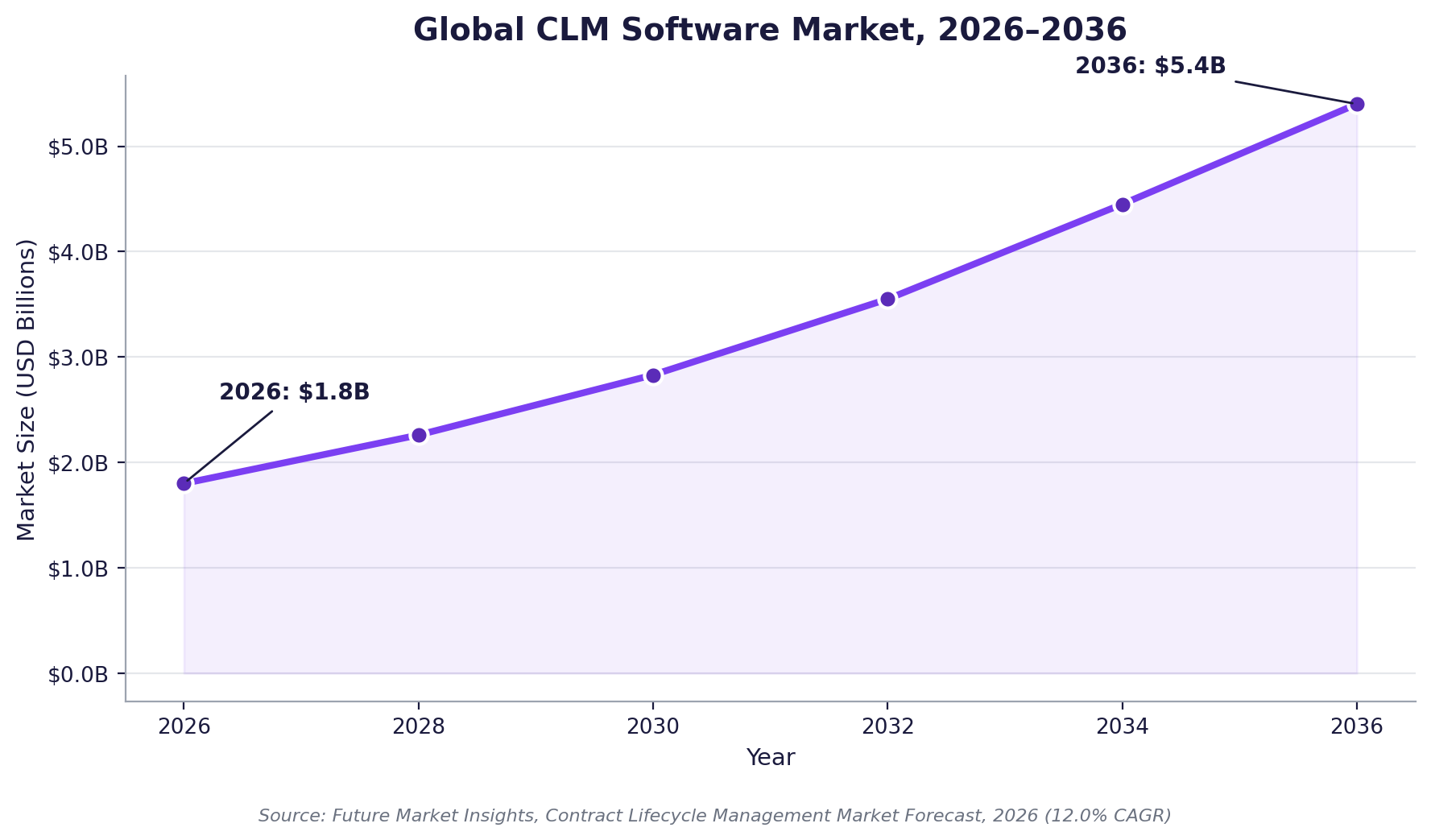
That replacement cycle is expensive in ways that rarely show up on the original business case. It is not just the cost of a second license. It is the lost years of contract data that never made it into either system cleanly, the internal credibility a legal operations team spends and does not get back, and the default reversion to email threads and shared drives that happens every time a rollout stalls.
The Expectation Gap
Here is the number that should reframe how every legal operations leader thinks about a CLM investment. According to Gartner, nearly half of CLM implementations fall short of the expectations that justified buying them in the first place.
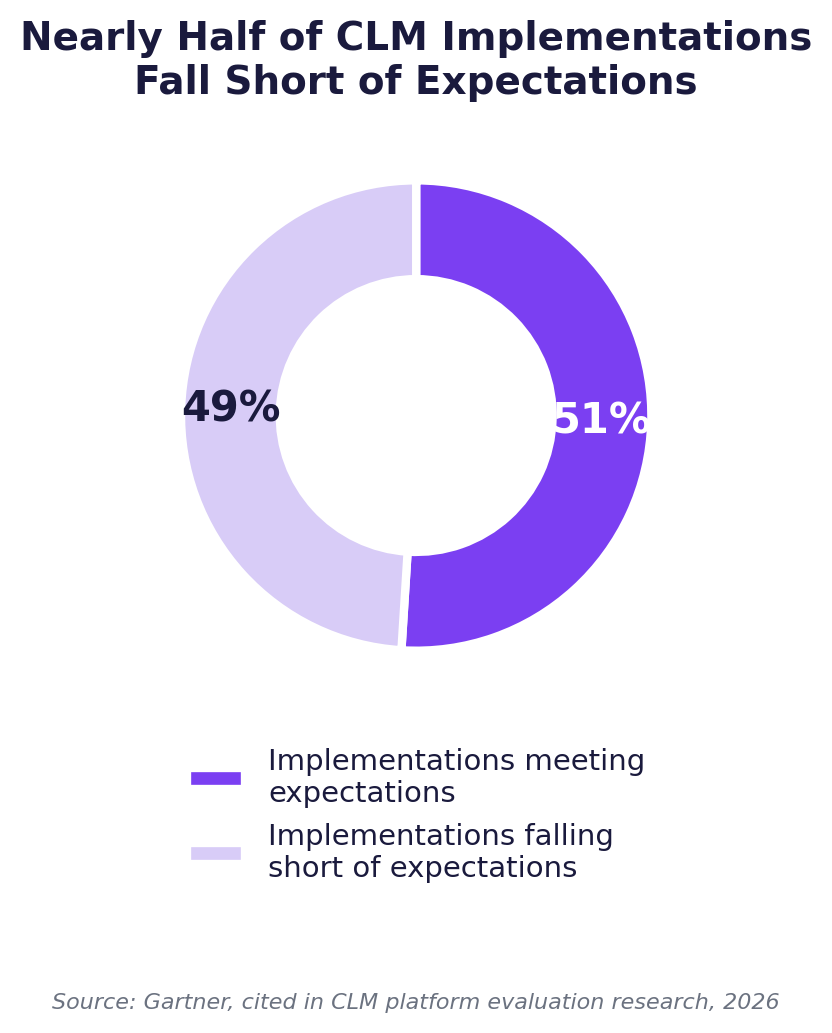
That is not a technology failure rate. Most CLM platforms on the market today are genuinely capable systems. The research on why implementations fall short points somewhere else entirely: overcustomization that makes the platform fragile and expensive to maintain, poor user adoption because the system does not fit how people actually work, and a basic misalignment between the team that selected the platform and the team that has to live inside it every day.
A platform that users quietly abandon delivers zero return on investment, no matter how sophisticated its feature list looked in the sales demo.
This is the part that gets missed in most CLM business cases. The purchase decision and the value decision are made by different people, at different times, under different pressures. Procurement and legal leadership evaluate the platform. Line attorneys, sales operations, and procurement staff have to actually use it, months later, after the people who ran the evaluation have moved on to the next project.
The Real Cost of Standing Still
The financial case for closing this gap is not abstract. Research from World Commerce and Contracting and Deloitte converges on a consistent finding: the average organization loses around 9 percent of its annual contract value to poor contract management, through missed obligations, pricing inconsistencies, uncaptured renewals, and compliance failures that surface too late to fix.
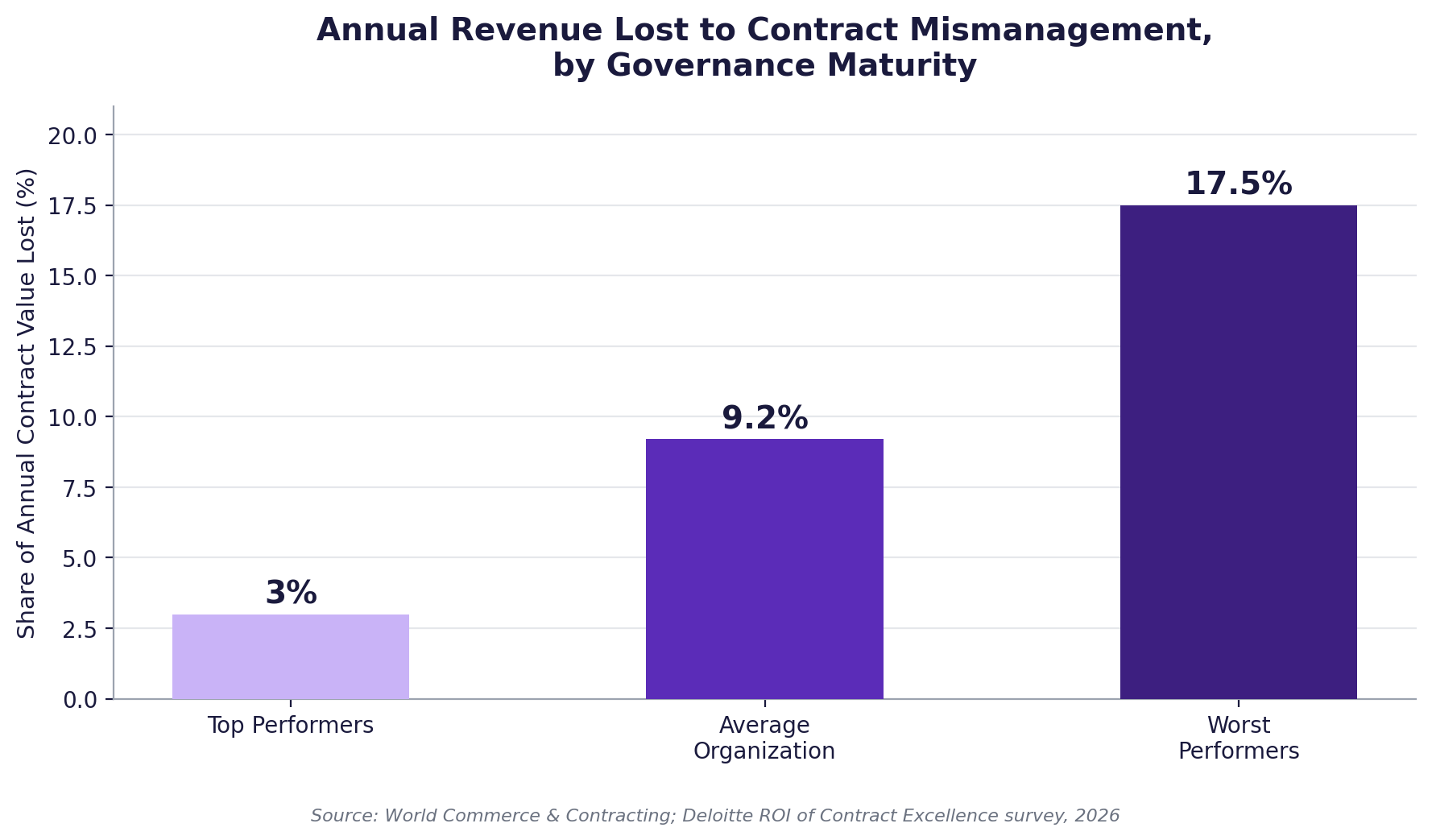
The gap between the best and worst performers is not small. Top performers hold that leakage to around 3 percent through disciplined governance. Organizations with the weakest contract oversight lose closer to 17 or 18 percent, and in the most severe cases, poor governance has been shown to erode as much as 40 percent of a contract's total value over its lifetime. A separate finding worth sitting with: 71 percent of businesses cannot locate at least one in every ten of their own contracts. A CLM platform is supposed to solve exactly that problem. Buying one does not solve it. Running it well does.
The Four Pillars of Post-Implementation Governance
At Roshwin, when we assess why a CLM program is or is not delivering value, we look past the platform entirely and evaluate the governance model sitting underneath it. Four things consistently separate programs that keep delivering value from programs that quietly stall within a year of go-live.
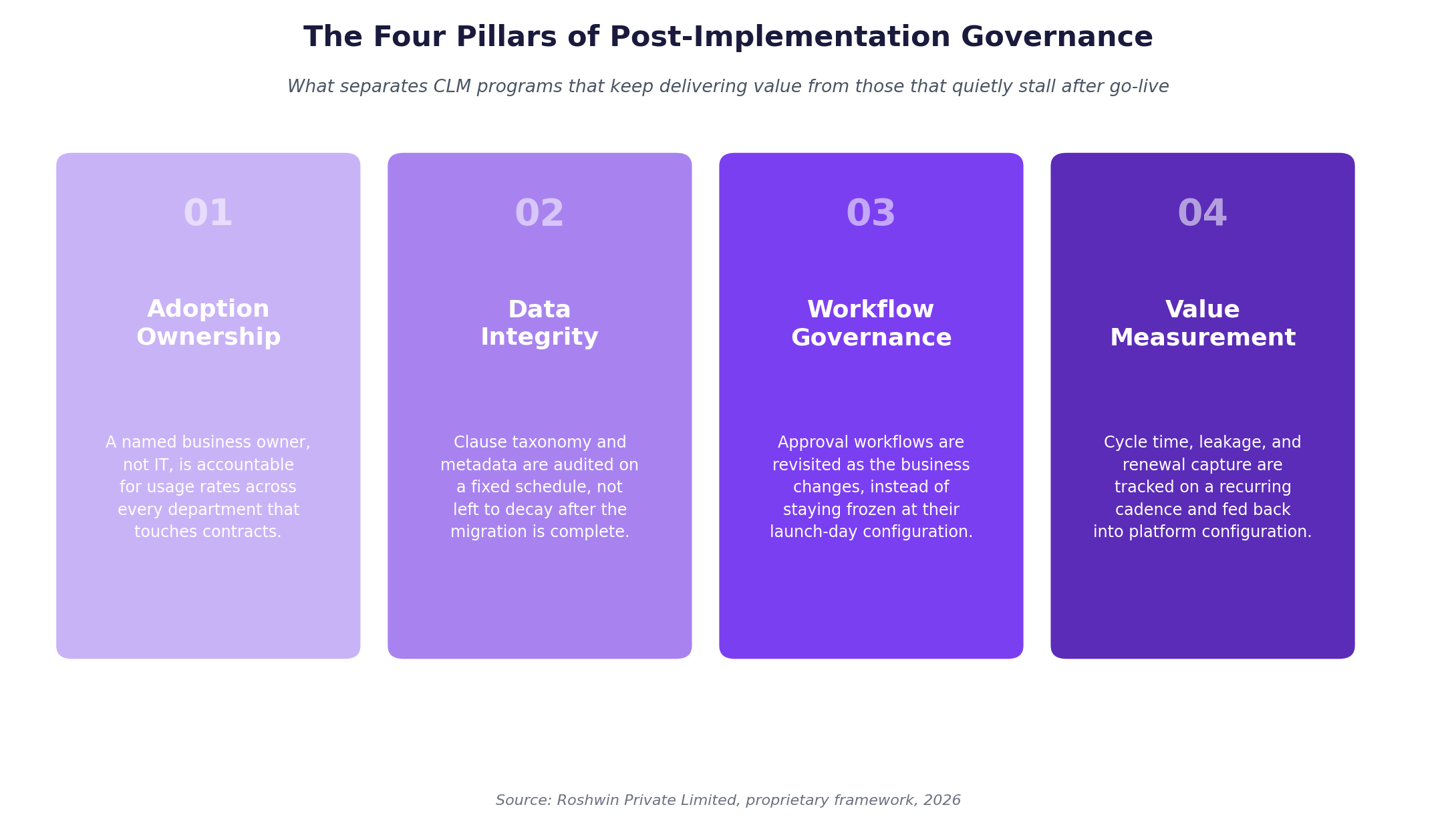
Pillar 1: Adoption Ownership. Someone outside IT, usually a legal operations lead, is personally accountable for usage rates across every department that touches contracts, not just the legal team.
Pillar 2: Data Integrity. Clause taxonomy and contract metadata are audited on a fixed recurring schedule. Data quality is treated as ongoing maintenance, not a one-time migration task that ends when the platform goes live.
Pillar 3: Workflow Governance. Approval workflows are revisited as the business changes. Org charts shift, approval thresholds move, and new contract types appear. A workflow frozen at its launch-day configuration becomes a source of friction within a year.
Pillar 4: Value Measurement. Cycle time, leakage, and renewal capture are tracked on a recurring cadence, and that data is fed back into how the platform is configured. Without this feedback loop, nobody notices the program has stalled until the contract before renewal date is already gone.
None of these four pillars require new software. They require an operating rhythm that most organizations never establish, because the implementation project plan usually ends at go-live and nobody owns what happens after.
What This Means for Legal Operations Leaders
Name a business owner for CLM adoption before implementation starts, not after usage rates disappoint someone in a quarterly review.
Build a data integrity audit into the calendar on a fixed cadence, the same way you would schedule any other compliance review.
Revisit workflow configuration at least twice a year. Treat the launch-day setup as a first draft, not a finished product.
Track leakage and renewal capture as standing metrics, and report them the same way you would report any other budget line with real financial consequences.
Conclusion
The organizations getting real value from contract lifecycle management are not the ones with the most advanced platform. They are the ones that treated go-live as the beginning of the work rather than the end of it. Roshwin's CLM advisory practice is built around exactly that discipline: helping legal teams build the governance model that keeps a platform delivering value years after the implementation team has moved on, instead of watching it quietly turn back into an expensive filing cabinet.
Put this into practice
Related ROSHWIN services
Legal operations, managed legal services and AI-enabled transformation, led by attorneys
ROSHWIN Private Limited works as an extension of corporate legal departments and law firms. Our attorney-led teams combine subject knowledge with responsible use of AI, so the work is fast, consistent and defensible, with pricing agreed up front.
Serving clients across the globe, including the United States, Canada, the United Kingdom and Europe, and the Middle East.
Continue reading
All insights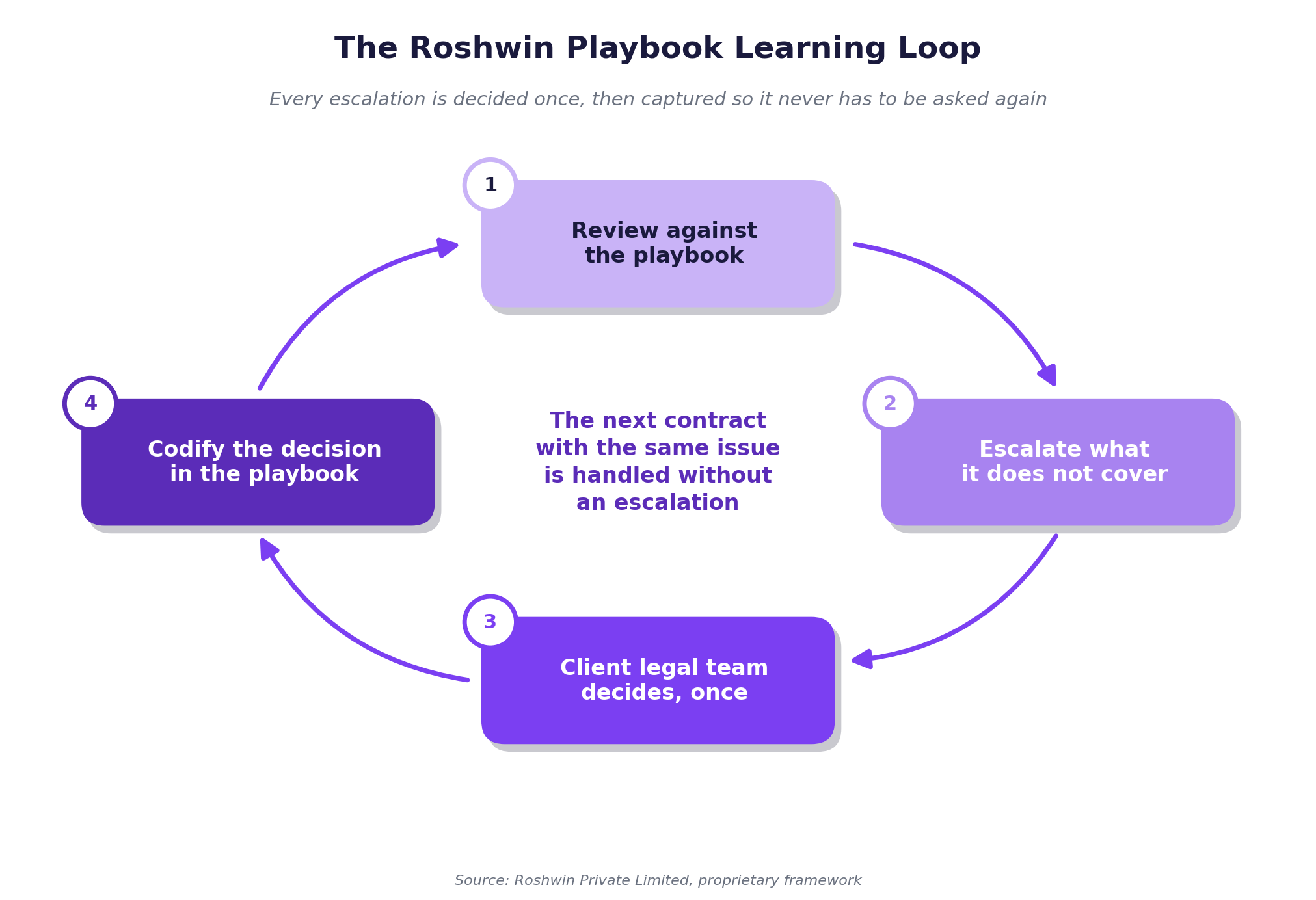
Playbooks That Learn: Contract Review With Falling Escalation Rates
How a contract review playbook turns every escalation into a decision made once, and why the best programs track how often they have to ask.
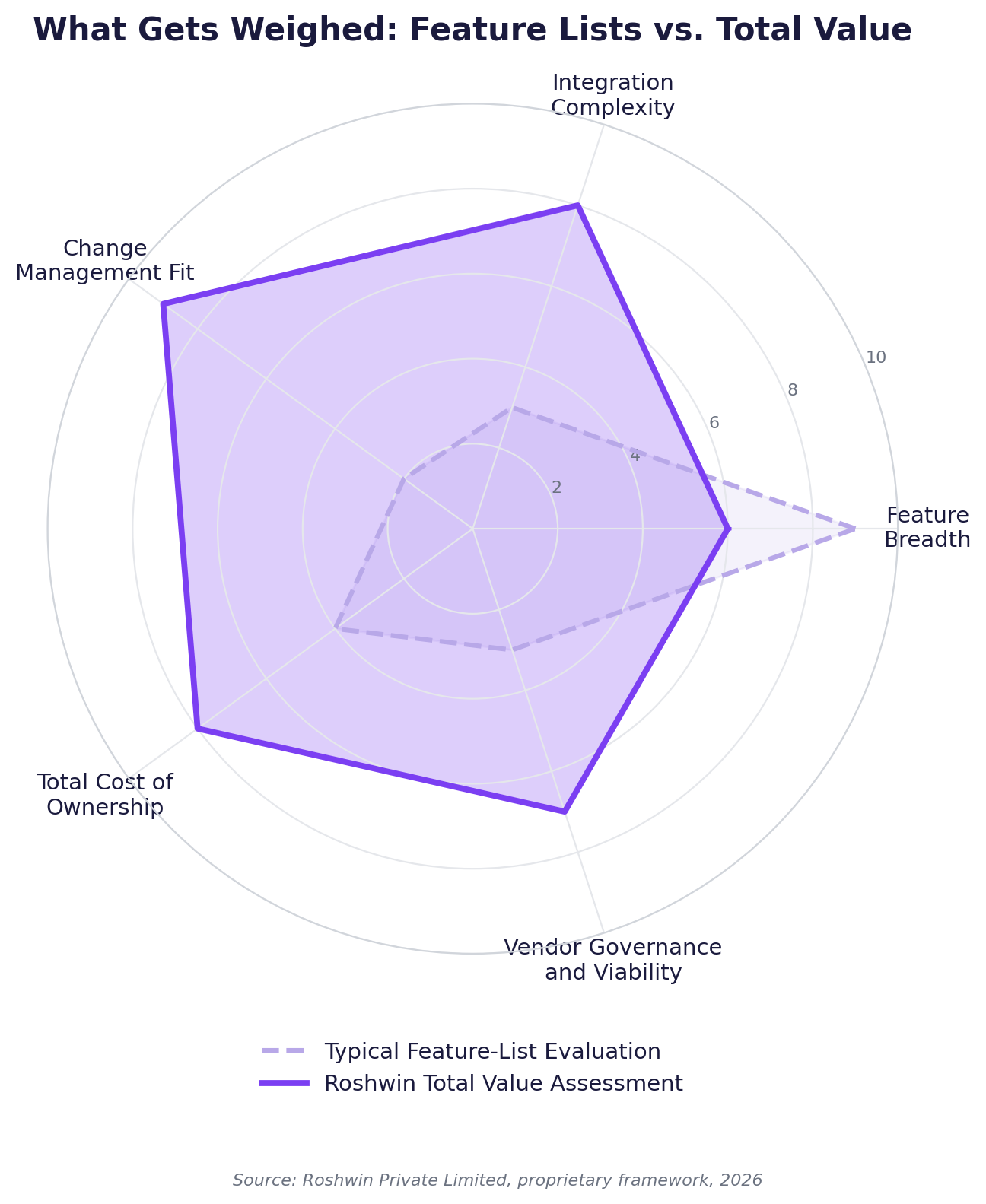
Evaluating Legal Technology: Beyond the Feature List
A framework for assessing legal technology investments that accounts for integration complexity, change management, and long-term total cost of ownership.