
The Middle Office: Unlocking Hidden Capacity in Legal Teams
How strategic middle-office support allows legal professionals to focus on high-value work while maintaining operational excellence in the background.
The capacity most legal departments are short of is not headcount. It is the hours their existing attorneys already have, buried under work that never required a law degree in the first place.
Every general counsel has heard the same request during budget season. The team needs more headcount, because the current attorneys are stretched too thin to take on new strategic work. It is a reasonable request on its face, and it is also, in a large share of legal departments, the wrong diagnosis. The actual constraint is rarely the number of attorneys. It is how much of each attorney's week survives contact with administrative work before any legal judgment gets applied at all.
This is the case for building what we call a middle office: a deliberate layer of specialized, non-attorney support that sits between strategic legal work and pure back-office processing. Done well, it does not shrink the legal team's footprint. It multiplies the capacity of the attorneys already on it.
Where the Week Actually Goes
The scale of the problem is larger than most legal leaders assume until they see it laid out. Bloomberg Law's 2024 Attorney Workload and Hours Survey, drawing on responses from over a thousand legal professionals, found that attorneys work an average of 48 hours a week, but only 36 of those hours are billable, judgment-based legal work. The remaining quarter of the week goes to administrative duties: tracking time, managing projects, and coordinating workflow that has nothing to do with legal training.
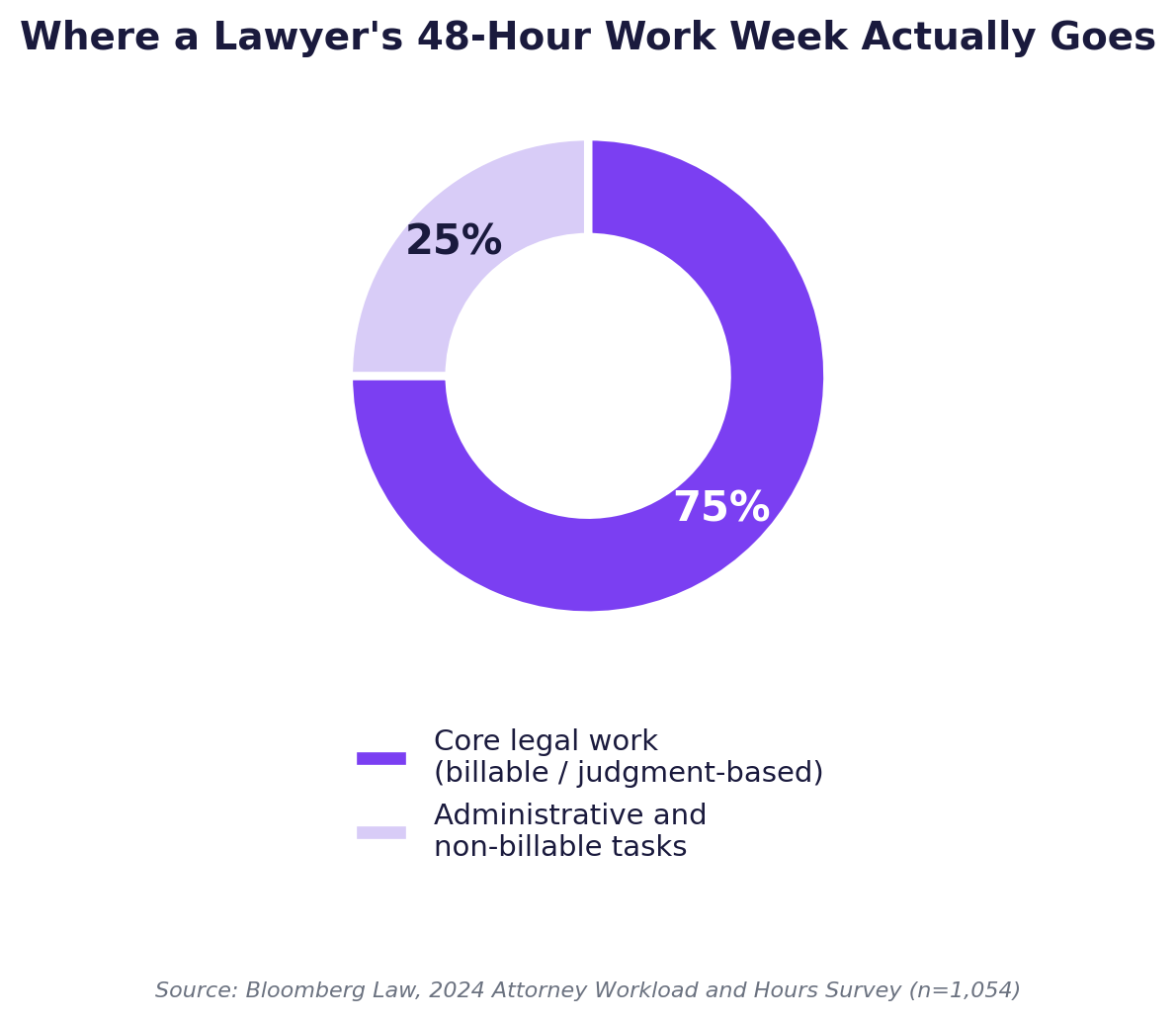
Other surveys put the administrative burden even higher, with estimates ranging as far as 48 percent of a legal professional's time in some studies, and separate research finding that 77 percent of small law firms report spending too much time on administrative tasks at the expense of practicing law. The exact number moves depending on who is measured and how, but every credible study lands in the same place: a meaningful fraction of an attorney's week, paid for at an attorney's cost, is spent on work that does not require a law degree.
Hiring another attorney to fix a capacity problem caused by administrative overload is like hiring another surgeon to fix a scheduling problem in the operating room.
The Market Has Already Noticed
Legal departments have started responding to this gap, and the response shows up clearly in how the alternative legal services market has grown. Alternative legal service providers (ALSPs), the category of firms and platforms built specifically to absorb specialized legal support work outside the traditional law firm model, represented a $31.5 billion global market in 2025 and are projected to reach $87.4 billion by 2034.
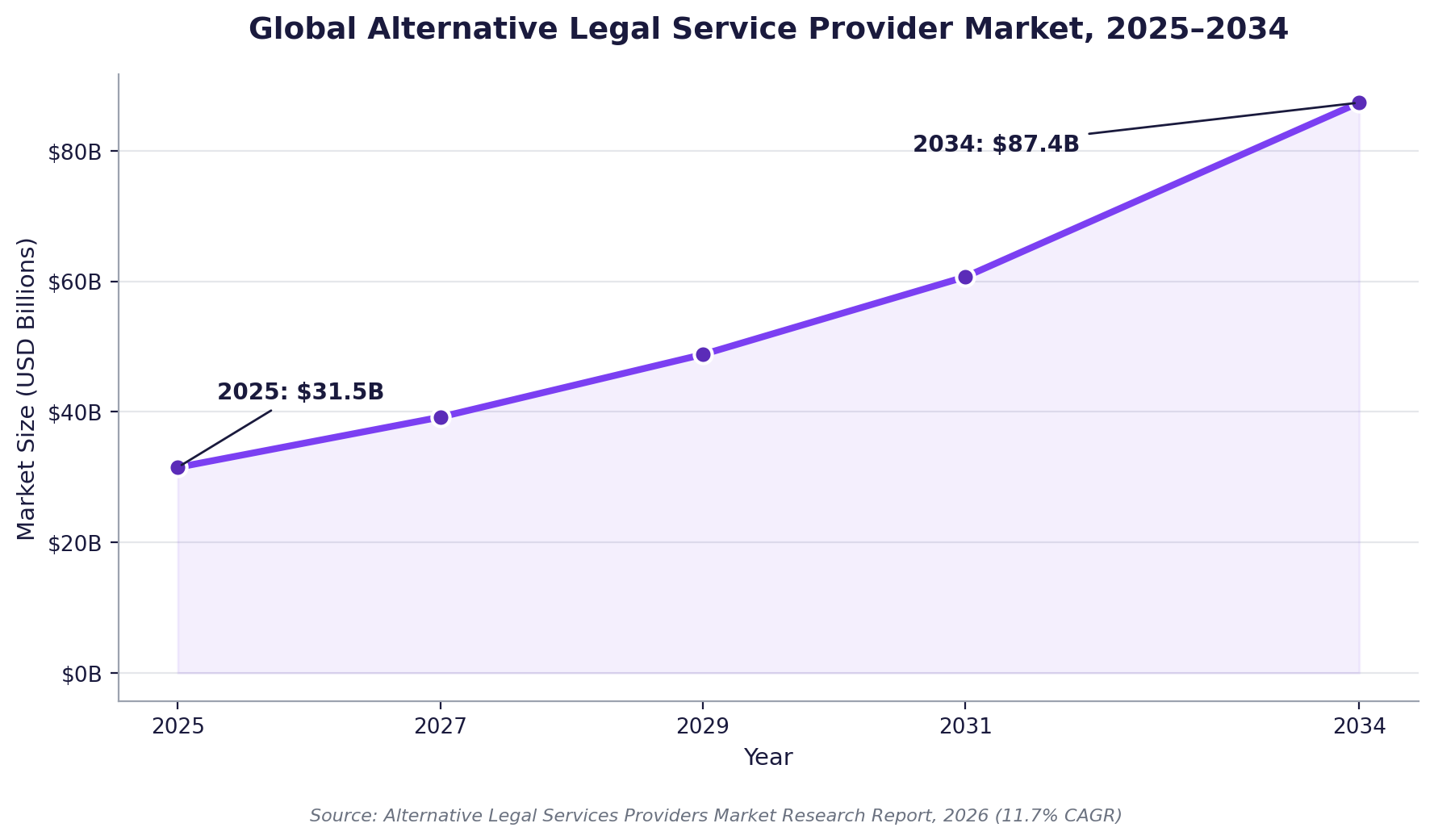
That growth is not being driven by cost-cutting alone, although cost is part of it. It reflects a structural recognition that a meaningful share of legal department work — from contract administration to compliance monitoring to e-billing review — is better handled by a specialized support layer than by an expensive attorney's hour or an overstretched paralegal doing it as an afterthought.
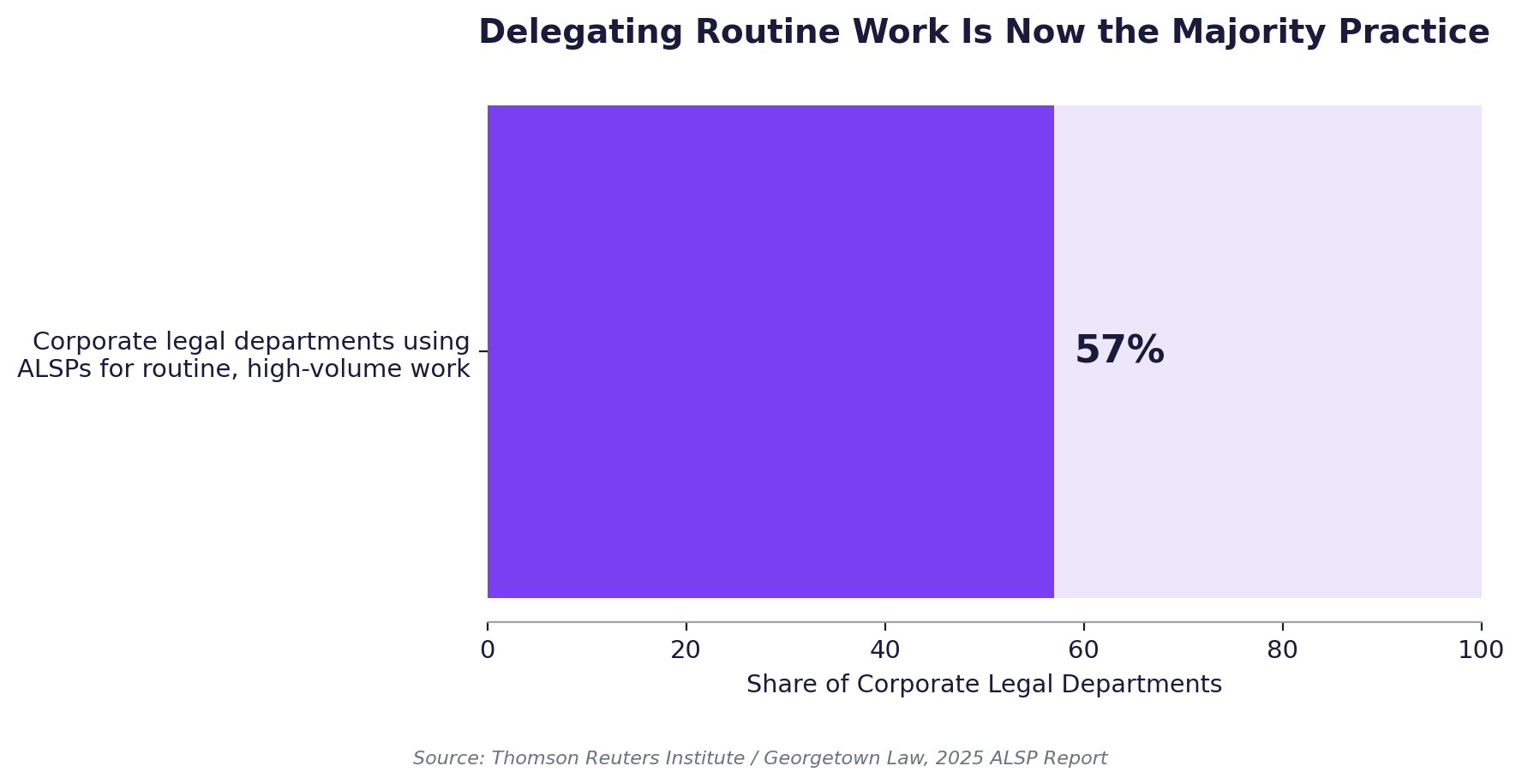
More than half of corporate legal departments now rely on alternative legal service providers for exactly this kind of routine, high-volume work. Delegating it is no longer the exception. It has become the majority practice among legal departments that have figured out where their real capacity constraint sits.
The Roshwin Middle Office Model
The mistake most legal departments make is treating this as a binary choice between doing everything in-house with attorneys, or outsourcing broadly and hoping quality holds. Neither extreme works well. What we use with clients instead is a three-tier model that draws a sharp line around what actually requires a licensed attorney's judgment, and treats everything else as a distinct operational layer with its own staffing and management logic.
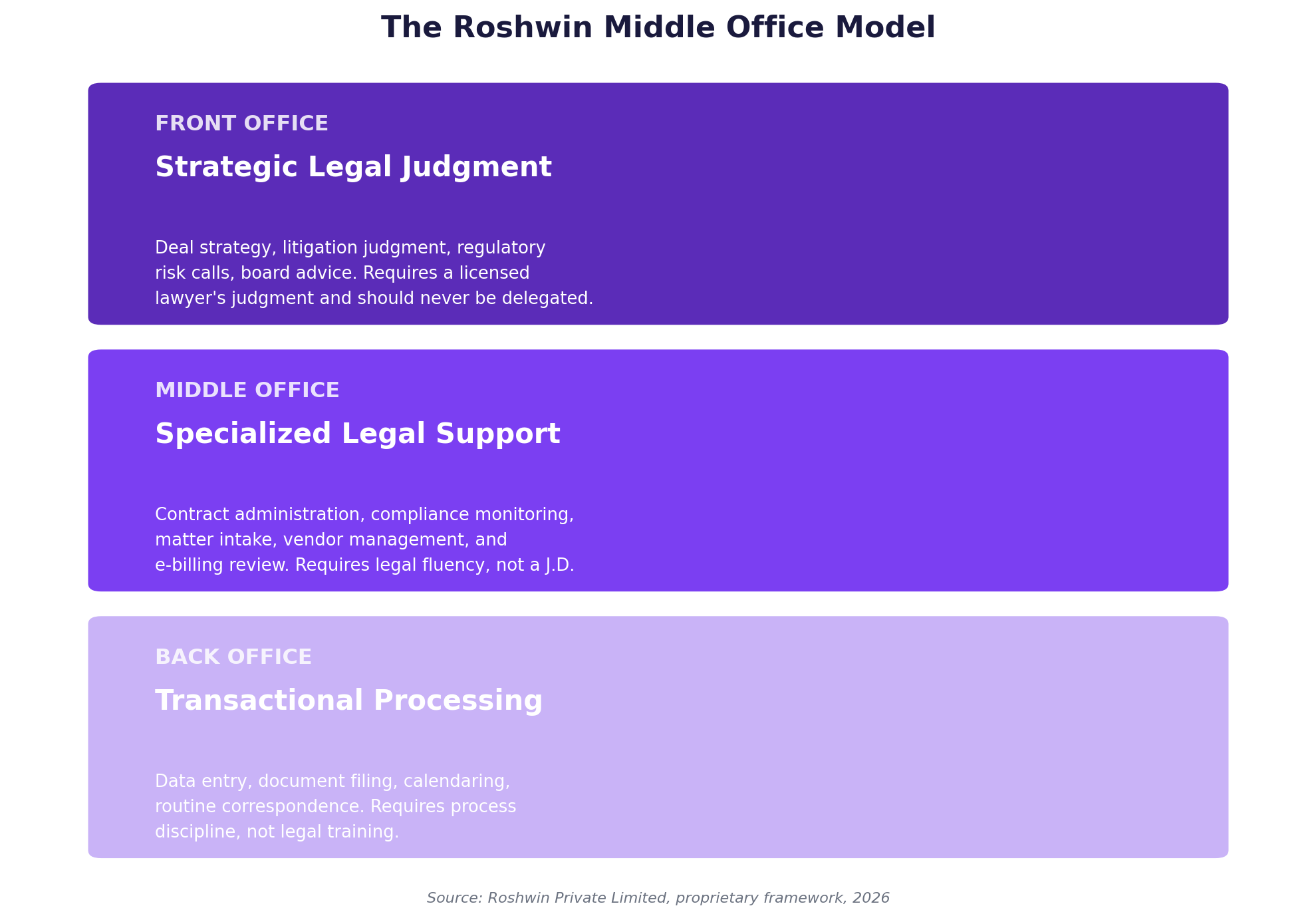
Front Office: Strategic Legal Judgment. Deal strategy, litigation judgment, regulatory risk calls, and board-level advice. This work requires a licensed attorney's judgment and legal training, and should never be delegated regardless of cost pressure.
Middle Office: Specialized Legal Support. Contract administration, compliance monitoring, matter intake, vendor and outside counsel management, and e-billing review. This work requires legal fluency — someone who understands legal workflows and terminology — but does not require a law degree.
Back Office: Transactional Processing. Data entry, document filing, calendaring, and routine correspondence. This work requires process discipline and attention to detail, not legal training of any kind, and is the easiest to standardize or automate.
The value of drawing these lines explicitly is that it turns a vague sense of being overwhelmed into a staffing decision. Most legal departments already have people doing middle-office and back-office work. The problem is that those people are usually the department's attorneys, doing it themselves because nobody ever built the layer that should be doing it instead.
A Middle Office Diagnostic
Before building or buying middle-office support, it is worth answering a short set of questions honestly. We use a version of this with clients as a starting diagnostic.
| Question | If Yes |
|---|---|
| Do your attorneys regularly do their own contract data entry, filing, or calendaring? | Back-office gap |
| Is compliance monitoring tracked manually by whoever has time, rather than owned by a dedicated role? | Middle-office gap |
| Do outside counsel invoices get reviewed by a partner-level attorney rather than a dedicated e-billing function? | Middle-office gap |
| Would your most senior attorney struggle to name what percentage of their week is spent on non-legal tasks? | Visibility gap |
| Has headcount been the default answer to capacity problems for the last two budget cycles? | Diagnosis gap |
A department answering yes to two or more of these is very likely sitting on hidden capacity that a middle-office layer — not another attorney — would unlock.
What This Means for General Counsel and Legal Operations Leaders
- Before requesting headcount, map how the current team's hours actually break down across front, middle, and back-office work. The data usually changes the request.
- Build or buy the middle-office layer deliberately, with its own management structure, rather than letting it accumulate informally on whichever attorney has the least pushback capacity.
- Treat ALSP and managed-service relationships as a staffing strategy on par with headcount planning, not a stopgap measure used only under budget pressure.
- Re-run the diagnostic annually. The line between middle-office and back-office work shifts as automation absorbs more of the purely transactional layer.
Conclusion
The legal departments getting the most out of their teams are not the ones with the most attorneys. They are the ones that built a deliberate layer of support underneath their attorneys, so that legal judgment gets spent on legal judgment. Roshwin's legal operations practice is built around exactly that model: helping legal departments find the capacity that is already on their team, before they go looking for capacity that has to be hired from outside.
Put this into practice
Related ROSHWIN services
Legal operations, managed legal services and AI-enabled transformation, led by attorneys
ROSHWIN Private Limited works as an extension of corporate legal departments and law firms. Our attorney-led teams combine subject knowledge with responsible use of AI, so the work is fast, consistent and defensible, with pricing agreed up front.
Serving clients across the globe, including the United States, Canada, the United Kingdom and Europe, and the Middle East.
Continue reading
All insights
Playbooks That Learn: Contract Review With Falling Escalation Rates
How a contract review playbook turns every escalation into a decision made once, and why the best programs track how often they have to ask.
Contract Intelligence: From Data to Strategic Insight
Transforming the contract repository from a static archive into a dynamic source of commercial intelligence and risk visibility.