
Modernizing Legal Departments Without Disruption
A phased approach to digital transformation that respects operational continuity and brings teams along, rather than imposing change on them.
A legal department cannot pause active matters while it rebuilds its own systems. Every modernization plan has to work around that constraint, not despite it.
Most digital transformation initiatives fail, and legal departments are not an exception to that pattern. Research from McKinsey has found that around 70 percent of transformation programs do not reach their targets, and the recurring cause is not the technology itself. It is insufficient change management. For a legal department, this failure mode carries a sharper edge than it does elsewhere in the business. A marketing team can pause a campaign to fix a broken workflow. A legal department cannot pause litigation, freeze contract execution, or tell a regulator that compliance monitoring is temporarily offline while the new system beds in.
That constraint is exactly why so many legal technology rollouts either stall halfway through or get pushed through in a way that damages trust with the very attorneys who were supposed to benefit from them. The fix is not a better vendor. It is a sequencing discipline that most transformation plans skip entirely.
Why the Standard Playbook Breaks in Legal
Change management research is unambiguous about what separates successful transformations from failed ones, and the gap is larger than most executives expect.
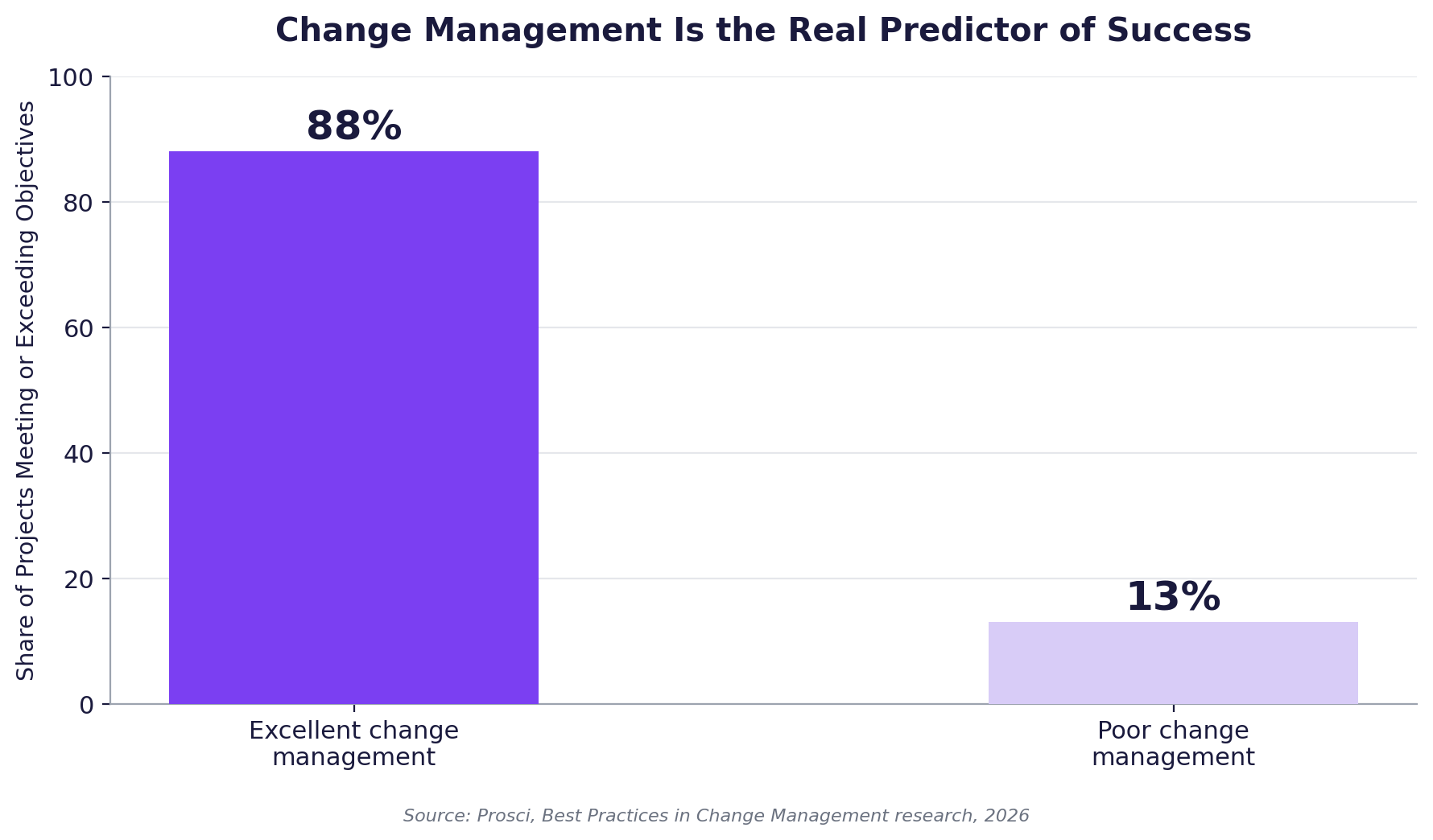
Projects with excellent change management meet or exceed their objectives 88 percent of the time. Projects with poor change management succeed only 13 percent of the time. That gap holds across industries, but it is more punishing in legal departments specifically, because the people being asked to change their workflow are the same people responsible for managing the organization's legal risk. An attorney who does not trust a new system will not stop doing the work. They will simply do it twice, once in the new system to satisfy the mandate, and once the old way to make sure nothing falls through.
A rollout that attorneys do not trust does not get abandoned. It gets duplicated, quietly, at twice the cost and none of the benefit.
The Legal-Specific Complication
There is a second factor that makes legal transformation harder than transformation elsewhere in the business, and it is rarely named directly. A meaningful share of legal department work is genuinely becoming automatable, but the share that is not automatable requires exactly the kind of judgment that erodes fastest under a disruptive, poorly sequenced rollout.
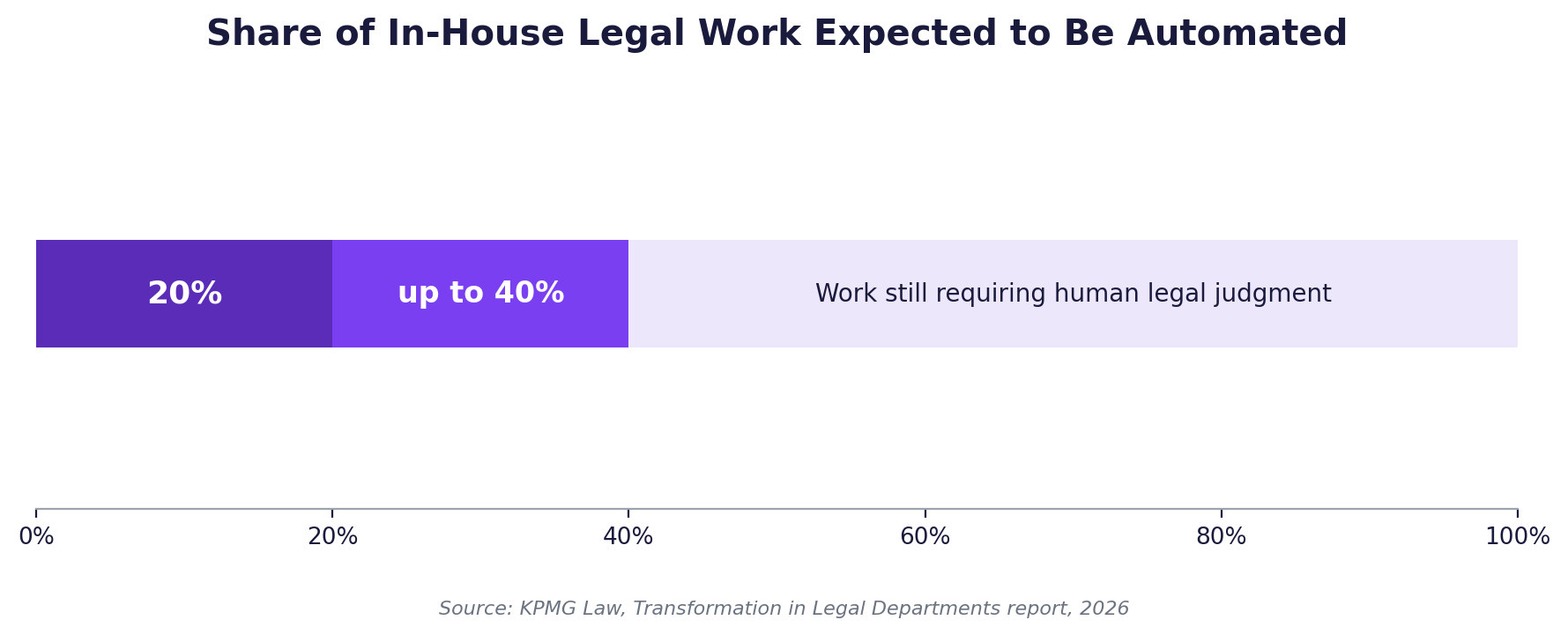
Research from KPMG Law puts the automatable share of legal department work in the range of 20 to 40 percent over the coming years, and the composition of legal teams is already shifting to reflect that. As recently as 2024, roughly 85 percent of legal department headcount consisted of fully qualified attorneys. That proportion is falling as departments bring in process specialists and legal technologists alongside traditional legal hires. This is a real and permanent shift, not a temporary disruption. But it only works if the automation is introduced in a way that lets attorneys keep doing the 60 to 80 percent of the work that still requires their judgment, without interruption, while the automatable share is carved off carefully.
The Roshwin Phased Modernization Roadmap
At Roshwin, we sequence legal technology rollouts around a four-phase model built specifically around the constraint that legal departments cannot stop operating while they modernize.
Phase 1: Stabilize. Before any system changes, map the current workflow end to end, including the informal steps nobody wrote down. This phase touches no active matter and changes nothing. Its only output is an honest picture of how work actually happens today.
Phase 2: Pilot. Run the new process alongside the old one, on a single team or a single matter type. The old process stays available as a fallback for the entire pilot. Nobody is forced to trust the new system before it has earned that trust.
Phase 3: Scale. Extend the proven workflow team by team, using the attorneys who succeeded in the pilot as internal champions. Peer credibility moves adoption faster than any mandate from legal operations or IT.
Phase 4: Institutionalize. Retire the legacy process only once the new one has become the default choice, is fully documented, and is owned by someone other than the person who built it. A transformation that depends on one champion staying in the role forever is not finished.
The sequence is deliberately slower than most vendors recommend. That is the point. A rollout measured in quarters, that attorneys actually trust and use, delivers more value than a rollout measured in weeks that gets quietly abandoned six months later.
What This Means for General Counsel and Legal Operations Leaders
Budget change management as its own line item, not as a rounding error inside the technology license. The research suggests it is the single biggest determinant of whether the investment pays off.
Resist any vendor timeline that skips a genuine pilot phase with a working fallback. A pilot without a fallback is not a pilot. It is a forced migration with extra steps.
Identify pilot champions before the pilot begins, not after. Peer credibility is what moves the scale phase, and it cannot be manufactured after the fact.
Treat the automatable and non-automatable portions of legal work as separate workstreams with separate change plans, rather than a single undifferentiated rollout.
Conclusion
Legal departments do not fail at modernization because they picked the wrong software. They fail because the rollout was sequenced as if the department could pause its core work while the system changed underneath it. It cannot. Roshwin's transformation advisory practice is built around that single constraint: sequencing change so the department keeps functioning throughout, and so the attorneys who have to live with the new system trust it enough to actually use it.
Put this into practice
Related ROSHWIN services
Legal operations, managed legal services and AI-enabled transformation, led by attorneys
ROSHWIN Private Limited works as an extension of corporate legal departments and law firms. Our attorney-led teams combine subject knowledge with responsible use of AI, so the work is fast, consistent and defensible, with pricing agreed up front.
Serving clients across the globe, including the United States, Canada, the United Kingdom and Europe, and the Middle East.
Continue reading
All insights
Evaluating Legal Technology: Beyond the Feature List
A framework for assessing legal technology investments that accounts for integration complexity, change management, and long-term total cost of ownership.
Playbooks That Learn: Contract Review With Falling Escalation Rates
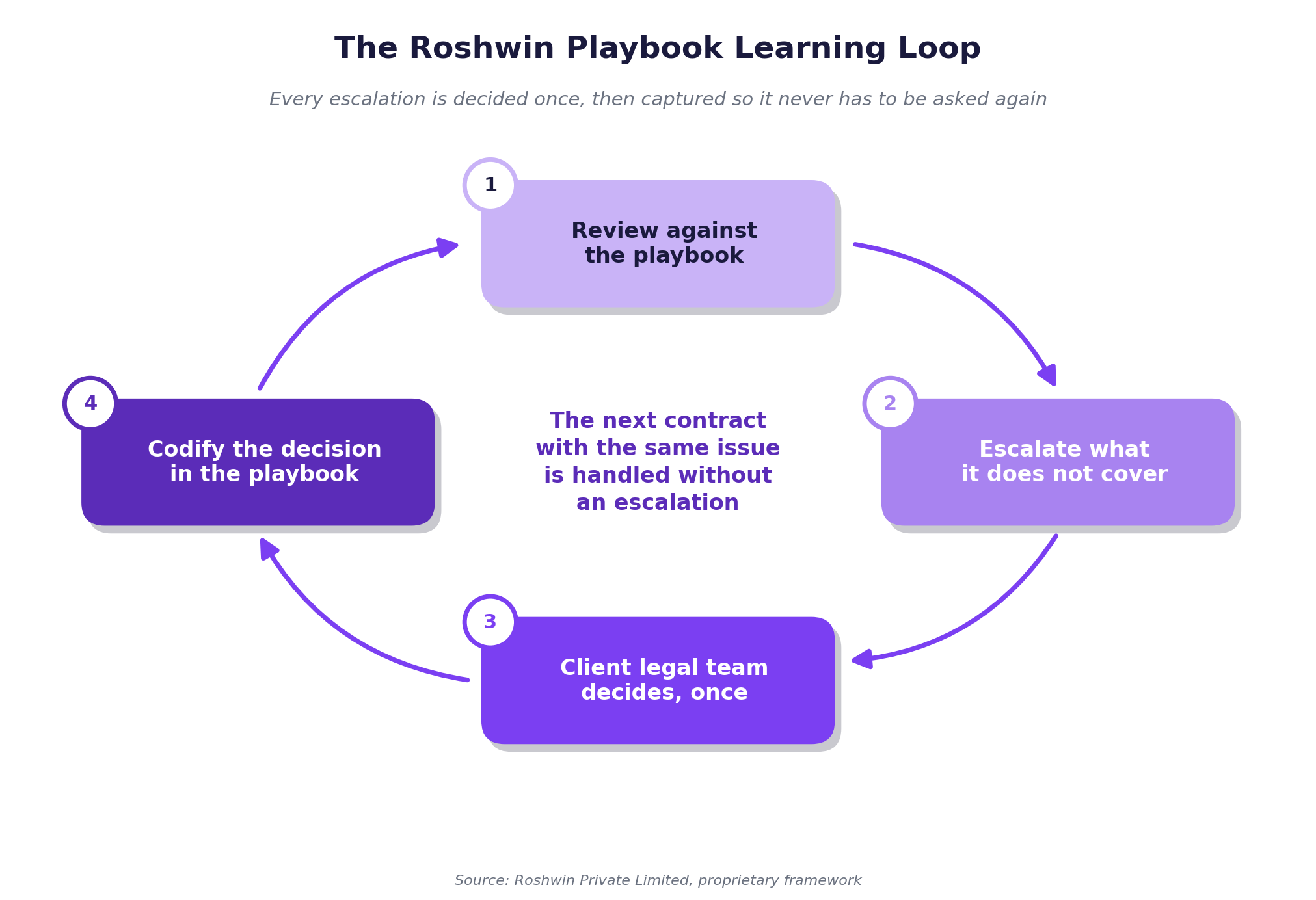
How a contract review playbook turns every escalation into a decision made once, and why the best programs track how often they have to ask.