
The Future of AI-Assisted Document Review in Legal Proceedings
A framework for evaluating where human judgment ends and machine assistance begins, and why that line is now a matter of legal defensibility, not just efficiency.
Document review has quietly become the most expensive line item in litigation and investigations. It is also the least defensible when done badly, whether by an untrained associate or an unsupervised model.
For three decades, document review was the part of litigation everyone complained about and nobody questioned. Junior attorneys and contract reviewers worked through custodial files page by page. The pace and cost made large-scale discovery a budget line unto itself. That model is now obsolete. Not because reviewers got faster, but because the volume of discoverable data outgrew human throughput by an order of magnitude. Generative AI arrived just as the gap became unmanageable.
The conversation legal teams need to have in 2026 is no longer whether to use AI in document review. Adoption has already crossed that threshold. The real question is where human judgment sits in the workflow, how that placement is documented, and whether it will hold up when a court, a regulator, or opposing counsel asks the team to defend it. This piece sets out what the data shows, what courts have actually required, and a framework we use at Roshwin to help legal teams answer that question with precision rather than guesswork.
The Scale Problem
Discoverable data has grown faster than any review model built around human throughput could absorb. Global data volumes are on a trajectory from roughly 181 zettabytes in 2025 toward more than 800 zettabytes by 2030. That is a compounding rate that dwarfs the growth of legal budgets or headcount over the same period. The eDiscovery market has responded by compounding at close to 10% annually for over a decade, absorbing that pressure mostly through technology rather than proportional increases in reviewer hours.
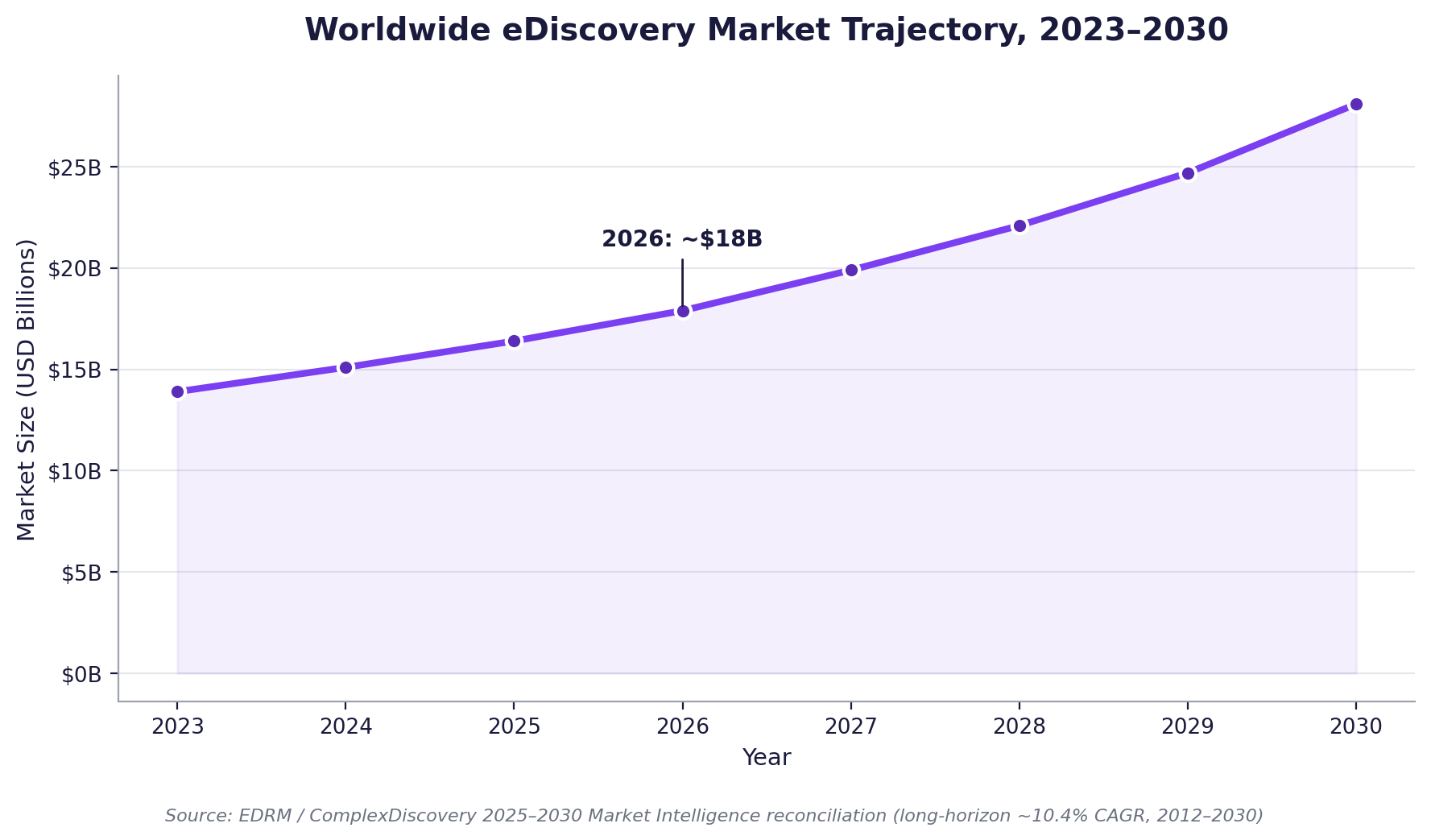
The trend line hides a more important shift underneath it. Per-unit review cost is compressing even as total spend rises, because AI-assisted review is absorbing a growing share of the underlying document volume. That is the real story for corporate legal departments and law firms alike. The market is not simply getting bigger. It is getting more efficient per document. Organizations that have not restructured their review workflows around that fact are paying a legacy tax on every matter.
What Courts Actually Require
Much of the anxiety around AI in document review comes from a misunderstanding of what courts have actually asked for. The foundational precedent remains Magistrate Judge Andrew Peck's 2012 opinion in Da Silva Moore v. Publicis Groupe. That case approved the use of technology-assisted review on the basis that it was, in his words, at least as accurate as, and considerably more efficient than, exhaustive manual review. Peck's opinion did not turn on the sophistication of the algorithm. It turned on transparency. The producing party had disclosed its methodology, allowed opposing counsel visibility into the training process, and could explain how the tool reached its classifications.
That standard — a defensible process over impressive technology — has held for over a decade and is now being extended explicitly to generative AI. The U.S. Judicial Conference's proposed Federal Rule of Evidence 707, out for public comment into 2026, would formally govern the admissibility of AI-generated evidence. It would require proponents to address reliability, methodology, and the basis for any AI-assisted conclusion before it is relied upon. Separately, courts are increasingly treating outputs from AI tools used during a matter as discoverable, ordinary electronically stored information. That means how a legal team used AI during review is itself becoming a fact pattern opposing counsel may probe.
The lesson from over a decade of TAR case law is consistent. Courts do not require perfect technology. They require a process a legal team can explain, defend, and reproduce.
For legal operations leaders, this reframes the AI adoption question. The relevant diligence question is not "which vendor has the best model" but "can we reconstruct and defend exactly how a document was classified, six months after the fact, in front of a judge who has never used the tool." Teams that treat AI-assisted review as a documented, auditable process — with sampling rates, validation protocols, and human override records — are building the same defensibility that made TAR judicially acceptable in the first place. Teams that treat it as a black-box efficiency layer are building risk instead.
The Efficiency Case, With Evidence
The efficiency argument for AI-assisted review is no longer speculative. Across reported operational benchmarks in 2026, the gains cluster in a consistent range regardless of which stage of the review workflow is measured.
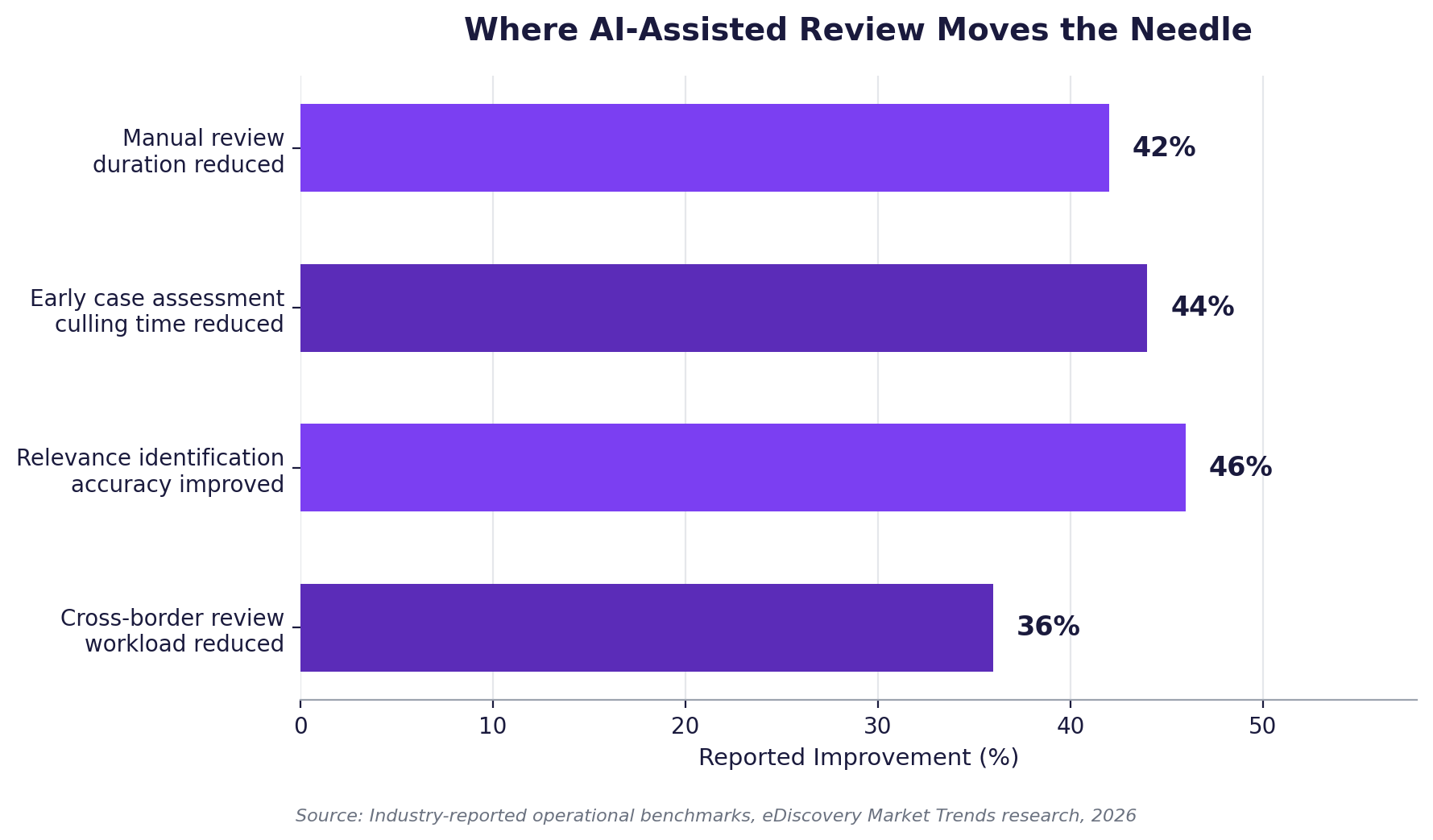
Two figures are worth sitting with. First, generative AI-assisted review is now commercially priced on a per-document basis in a $0.11 to $0.50 range, according to the eDiscovery industry's most recent independent pricing survey. That figure competes directly and transparently with the fully loaded cost of first-pass human review at scale. Second, cross-border investigations — historically the most expensive and slowest category of review because of multilingual custodial data and jurisdiction-specific privilege rules — are seeing AI-assisted workload reductions approaching 36%. That is precisely where the cost of delay is highest.
These numbers explain the adoption curve, but they should not be read as a case for unsupervised automation. Every one of these efficiency studies measures AI-assisted review, not AI-only review. The efficiency gain is a function of how well human expertise is deployed against the 5–15% of documents that genuinely require judgment, not a function of removing human judgment from the workflow.
Introducing the Human-AI Review Maturity Framework
Most legal teams cannot answer a simple question with precision: which review methodology are we actually using, and how far along the maturity curve does it sit? "We use AI" is not an answer a court, a general counsel, or a client audit will accept. At Roshwin, we assess review workflows against a five-level maturity model, built from what we have seen distinguish defensible AI-assisted programs from exposed ones across managed review engagements.
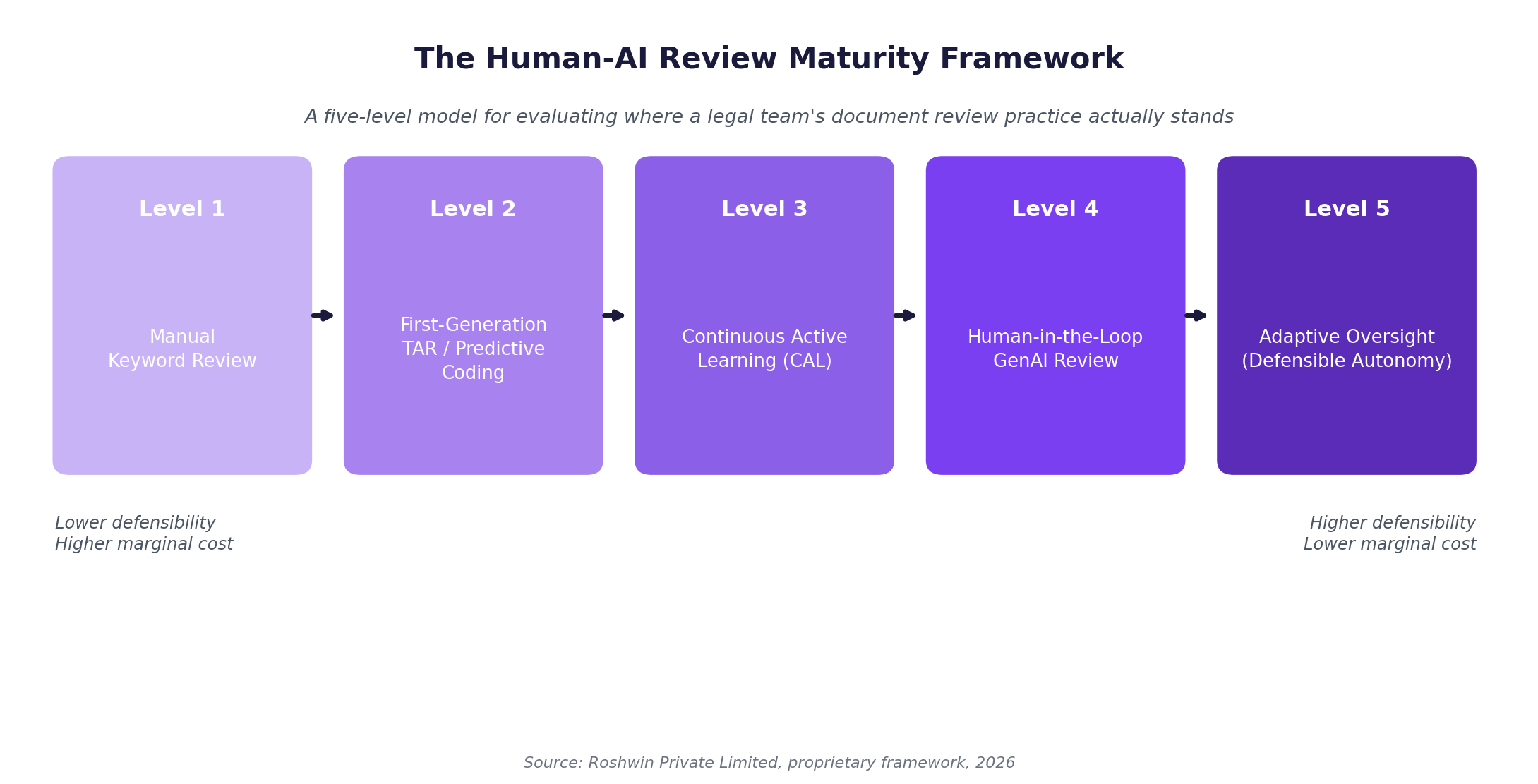
Level 1: Manual Keyword Review. Boolean search terms narrow the population, and every resulting document is reviewed by a human. This is defensible but economically unsustainable above a few hundred thousand documents. It is also the weakest at catching conceptually relevant material that does not match the search terms.
Level 2: First-Generation TAR / Predictive Coding. A static model is trained once on a seed set and applied to the remaining population, with review confined largely to model output. This approach is efficient and judicially well-established since Da Silva Moore, but it can be brittle when case theory evolves mid-review.
Level 3: Continuous Active Learning (CAL). The model retrains continuously as reviewers code documents, re-ranking the remaining population in real time. This is the current baseline for defensible large-scale review and the floor most sophisticated litigation teams now expect.
Level 4: Human-in-the-Loop GenAI Review. Large language models perform first-pass classification, summarization, and privilege flagging. Human reviewers validate a statistical sample and review anything the model flags as uncertain, privileged, or sensitive. This is where most well-run programs sit today, and it is where the cost and accuracy data above is actually measured.
Level 5: Adaptive Oversight (Defensible Autonomy). Human reviewers shift from document-level review to system-level oversight. They audit model drift, sample accuracy over time, and maintain the documentation trail that would satisfy a Rule 707 inquiry, while the model handles a much larger share of first-pass classification. Few programs operate here consistently yet. It is where the discipline is heading.
The framework is deliberately not a technology ladder. A team can own the most advanced GenAI platform on the market and still operate at Level 2 in practice, if it cannot document how documents move through the model or reconstruct a reviewer's override decision. Maturity, in this model, is a function of process discipline and documentation, not licensing spend.
Where This Is Headed
Three developments will shape the next two years of this discipline.
First, evidentiary rules are catching up to practice. With Rule 707 moving through the federal comment process, and state-level analogues emerging in California and Louisiana, disclosure obligations around AI-assisted work product will tighten, not loosen.
Second, pricing models are still unsettled. The same 2026 pricing survey that found the $0.11 to $0.50 per-document range also found no market consensus on how exception handling, quality control failures, or reprocessing costs should be allocated in GenAI-assisted contracts. That means legal teams negotiating these engagements today are setting precedent for their own future matters.
Third, and least discussed, the skill profile of a document reviewer is shifting from document-level judgment to system-level oversight. Most legal teams have not yet reflected that shift in how they train, staff, or evaluate review talent.
What This Means for Legal and Compliance Leaders
Audit your current review workflow against the five-level framework honestly. The answer is rarely where procurement documentation says it is.
Treat sampling rates, validation protocols, and override logs as the actual work product of an AI-assisted review program — not an afterthought to the technology license.
Build disclosure-readiness now. A Rule 707-style inquiry should be answerable from existing documentation, not reconstructed under deadline pressure.
Evaluate review talent and vendors on system-level oversight capability, not just per-document throughput. That is the skill the next stage of the maturity curve actually demands.
Conclusion
The organizations getting this right are not the ones with the most advanced models. They are the ones that can explain, to a skeptical judge or a nervous general counsel, exactly how a document moved from custodial collection to a privilege call, and why a human being made the decisions that mattered. That is the standard courts set in 2012, and it is the standard they are formalizing now.
Roshwin's managed review practice is built around exactly that discipline. AI does the first pass at scale, and trained legal professionals own the judgment calls that a court will eventually ask someone to defend.
Put this into practice
Related ROSHWIN services
Legal operations, managed legal services and AI-enabled transformation, led by attorneys
ROSHWIN Private Limited works as an extension of corporate legal departments and law firms. Our attorney-led teams combine subject knowledge with responsible use of AI, so the work is fast, consistent and defensible, with pricing agreed up front.
Serving clients across the globe, including the United States, Canada, the United Kingdom and Europe, and the Middle East.
Continue reading
All insights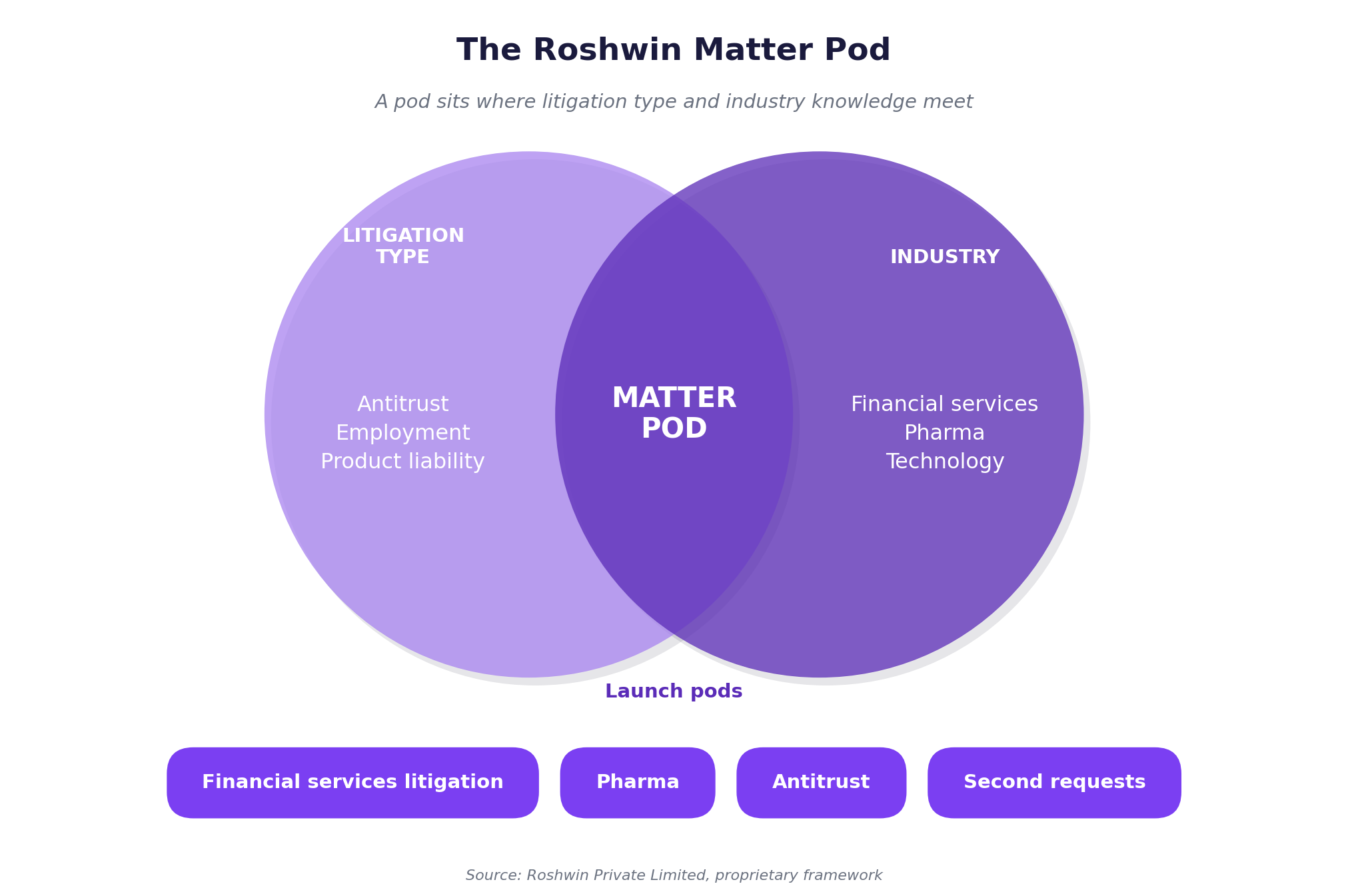
Matter Pods: Why Specialized Review Teams Beat Generic Review Pools
Why the team reviewing your documents should understand your case before it opens the first one, and how to build that into the workflow.
Modernizing Legal Departments Without Disruption
A phased approach to digital transformation that respects operational continuity and brings teams along on the journey rather than imposing change.